Fasting-Mimicking Diet (FMD) + Hyperbaric Oxygen Therapy (HBOT): A Metabolic Strategy Targeting Cancer Energetics
Introduction
In recent years, a new paradigm has emerged in oncology and longevity medicine:
👉 targeting cancer through its metabolism rather than only through cytotoxicity.Two central metabolic fuels sustain many tumors:
- Glucose (via aerobic glycolysis – the Warburg effect)
- Glutamine (for mitochondrial function and biosynthesis)
This has led to growing interest in interventions that simultaneously disrupt both pathways.Among these, the combination of:
- Fasting-Mimicking Diet
- Hyperbaric Oxygen Therapy
offers a non-pharmacological, systems-based approach to metabolic targeting.
The Metabolic Vulnerability of Cancer
4Cancer cells often exhibit:
- High dependence on glucose fermentation (Warburg effect)
- Increased reliance on glutamine metabolism (glutaminolysis)
- Dysfunctional or stressed mitochondria
- A hypoxic microenvironment
These features create a paradox:
👉 Cancer cells are highly adaptable, yet metabolically fragile under coordinated stress
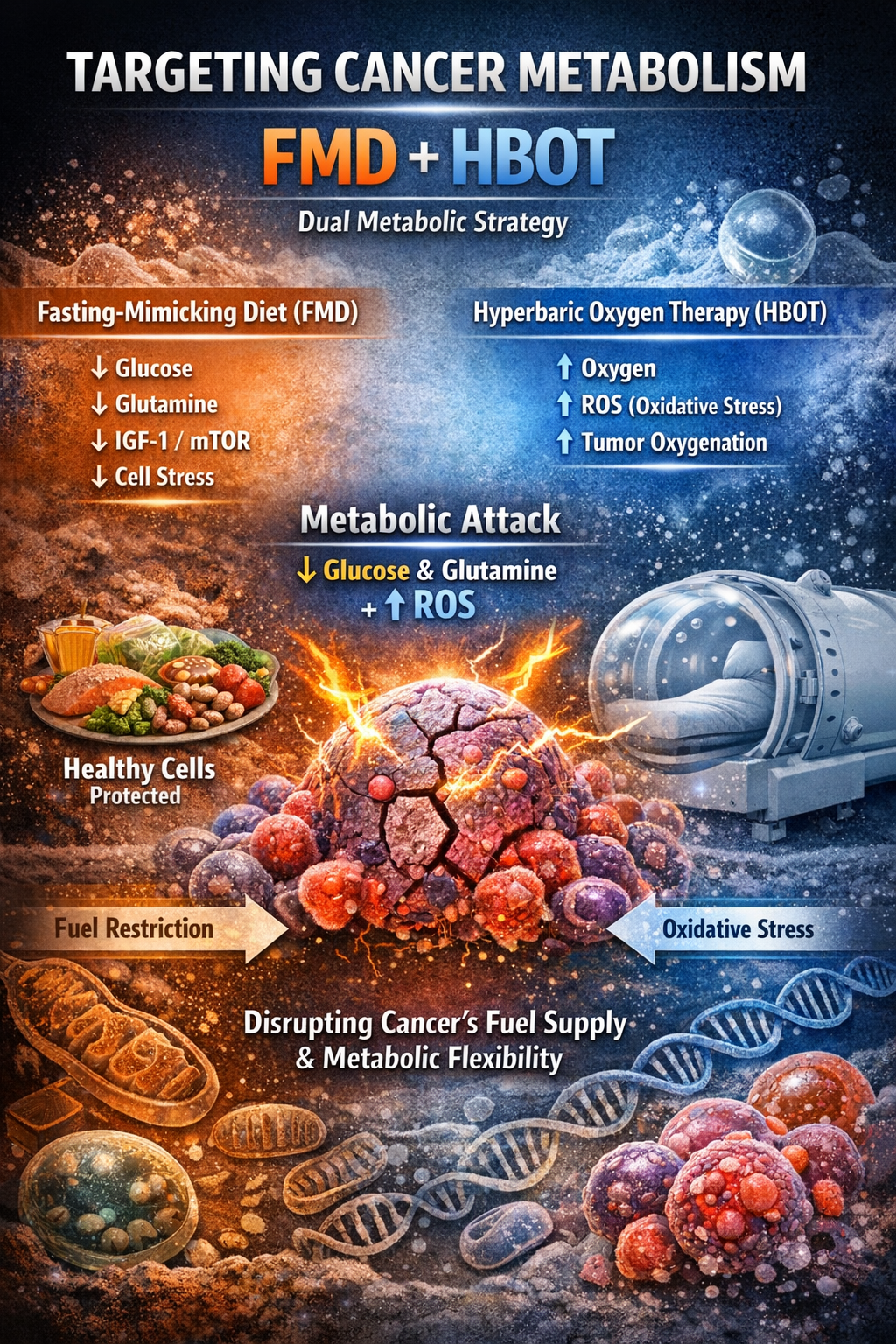
The Role of FMD: Systemic Metabolic Reprogramming
The FMD, pioneered by Valter Longo, is a low-calorie, low-protein, plant-based protocol designed to mimic fasting while maintaining safety and compliance.
Key metabolic effects:
- ↓ Blood glucose
- ↓ Insulin and IGF-1
- ↓ mTOR activation
- ↓ Protein intake → ↓ glutamine availability
- ↑ Ketogenesis and metabolic flexibility
👉 Result:
- Reduced fuel availability (glucose)
- Reduced growth signaling (IGF-1 / mTOR)
- Lower demand and partial restriction of glutamine pathways
Importantly, FMD induces a state of differential stress resistance:
- Healthy cells → enter protective mode
- Cancer cells → remain vulnerable
📚 Key references:
- Longo VD & Mattson MP. Cell Metabolism, 2014
- Brandhorst S et al. Cell Metabolism, 2015
The Role of HBOT: Oxygen as a Metabolic Stressor
HBOT (typically 2 ATA, 60–120 min) dramatically increases oxygen dissolved in plasma.
Biological effects:
- Reverses tumor hypoxia
- Forces cells toward oxidative metabolism
- Increases reactive oxygen species (ROS)
- Enhances mitochondrial activity
👉 Cancer cells—often reliant on glycolysis—struggle under these conditions.
Synergy: FMD + HBOT
The combination creates a dual metabolic pressure:
1. Fuel restriction (FMD)
- ↓ Glucose
- ↓ Glutamine signaling
2. Oxidative stress (HBOT)
- ↑ ROS
- ↑ Mitochondrial demand
The key insight
Cancer cells are pushed into a metabolic “trap”:
- Glucose is limited
- Glutamine pathways are constrained
- Oxygen forces mitochondrial respiration
- ROS levels increase
👉 This reduces metabolic flexibility, a hallmark of cancer survival.
The Perspective of Thomas Seyfried
Thomas Seyfried has been a leading advocate of the metabolic theory of cancer, arguing that:
Cancer is fundamentally a disease of mitochondrial dysfunction and altered energy metabolism.
He emphasizes:
- Targeting glucose and glutamine simultaneously
- Using non-toxic metabolic therapies
- Combining dietary strategies with oxidative stressors
📚 Key references:
- Seyfried TN. Cancer as a Metabolic Disease, 2012
- Seyfried et al. Nutrition & Metabolism, 2020
Why This Approach May Be Superior to Glutamine Blockers
Pharmacological glutamine inhibition (e.g., GLS inhibitors like CB-839) has gained attention. However, it presents several limitations:
1. Systemic toxicity and narrow targeting
Glutamine is essential for:
- Gut integrity
- Immune function
- Nitrogen balance
👉 Blocking it pharmacologically can:
- Impair immunity
- Damage healthy tissues
2. Metabolic compensation
Cancer cells can adapt by:
- Switching fuels (fatty acids, lactate, ketones)
- Increasing glucose uptake
👉 Single-pathway blockade often fails
3. Lack of systemic context
Drugs target enzymes but not the whole metabolic environment
In contrast: FMD + HBOT
| Feature | Glutamine Blockers | FMD + HBOT |
|---|---|---|
| Target scope | Single pathway | Multi-pathway |
| Systemic adaptation | High | Reduced |
| Toxicity | Potentially high | Generally low (if supervised) |
| Metabolic flexibility | Preserved | Collapsed |
Key advantage
👉 Instead of “blocking glutamine,”
you reduce its relevance and effectiveness
- ↓ intake (FMD)
- ↓ signaling (mTOR)
- ↑ oxidative stress (HBOT)
➡️ Cancer cells cannot compensate easily
Differential Stress: Protecting Healthy Cells
One of the most compelling aspects of this approach:
- Healthy cells:
- Activate repair pathways
- Increase antioxidant defenses
- Cancer cells:
- Remain metabolically inflexible
- Accumulate damage
👉 This creates a therapeutic window without direct toxicity
Limitations and Considerations
- Clinical evidence is still emerging
- Not all tumors respond equally
- Protocols must be personalized
- Should be used as an adjunct, not a replacement for standard care
Conclusion
The combination of:
- Fasting-Mimicking Diet (FMD)
- Hyperbaric Oxygen Therapy (HBOT)
represents a systems biology approach to cancer metabolism.Rather than targeting a single pathway, it:
- Reduces glucose availability
- Modulates glutamine utilization
- Increases oxidative stress
- Limits metabolic flexibility
👉 Aligning closely with the metabolic framework proposed by Thomas Seyfried
Final Insight
The future of oncology may not lie in stronger drugs,
but in smarter metabolic environments.
📚 Selected References
- Longo VD, Mattson MP. Fasting: Molecular mechanisms and clinical applications. Cell Metabolism, 2014
- Brandhorst S et al. A Periodic Diet that Mimics Fasting Promotes Multi-System Regeneration. Cell Metabolism, 2015
- Seyfried TN. Cancer as a Metabolic Disease. Wiley, 2012
- Seyfried TN et al. Metabolic therapy: A new paradigm for managing malignant brain cancer. Nutrition & Metabolism, 2020
- Poff AM et al. Ketogenic diet and hyperbaric oxygen therapy prolong survival in mice with systemic metastatic cancer. PLoS One, 2013
- Wallace DC. Mitochondria and cancer. Nature Reviews Cancer, 2012
